About PRGdb5
Welcome to PRGdb5, the latest version of the Plant Resistance Genes Database. This page highlights the key changes, new features, and improvements introduced in this version.
What's New in PRGdb5
1. Advanced Search System
The new Advanced Search feature provides powerful filtering capabilities to help you find exactly what you're looking for in the database.
How to Access
Click the (gear) icon next to the search bar in the navigation menu, or use the "Advanced Search" link in search results pages.
Features and Options
Operators
- AND: All criteria must match (default). Use this when you want results that satisfy all your conditions.
- OR: Any criterion can match. Use this when you want results that match at least one of your conditions.
- NOT: Exclude results matching this criterion. Use this to filter out unwanted results.
Searchable Fields
- Gene Name: Search by gene identifier or name
- Species Name: Filter by plant species (e.g., Solanum lycopersicum)
- Species TaxID: Search using NCBI taxonomy ID
- Agent Name: Find genes related to specific pathogens or agents
- Pest/Disease Name: Search by disease or pest name
- Reference Gene Name: Filter by reference resistance gene names
How to Use
- Start with the default row that appears when you open the modal.
- Select an operator (AND, OR, NOT) from the first dropdown.
- Choose a field type from the second dropdown (e.g., Gene Name, Species Name).
- Enter your search value in the text field.
- Click to add more criteria rows for complex searches.
- Click to execute your query, or to reset the form.
2. Enhanced Gene Details Integration
PRGdb5 now integrates with several external databases to provide comprehensive information about resistance genes.
STRING Database Integration
The STRING database provides protein-protein interaction networks and functional enrichment analysis.
- Interaction Networks: Visualize protein-protein interactions for your gene of interest
- Functional Enrichment: Discover enriched Gene Ontology (GO) terms from STRING's analysis
- GO Pathways: Additional GO terms from STRING are automatically merged with UniProt data
If STRING data is not available, you'll see a helpful message with a link to search directly on string-db.org.
Reactome Pathway Analysis
Reactome provides curated pathway information and pathway analysis tools.
- Pathway Enrichment: Discover which biological pathways are enriched for your gene
- Pathway Visualization: Interactive pathway diagrams using Reactome's Fireworks viewer
- Top Pathways: View the most significant pathways associated with your gene
If Reactome analysis is not available, you'll see a message with a link to reactome.org.
Expression Atlas Integration
Expression Atlas provides gene expression data across different conditions and tissues.
- Expression Heatmaps: Visualize gene expression patterns across different experimental conditions
- Tissue-Specific Expression: See where and when your gene is expressed
- Condition-Based Expression: Explore expression changes under different stress conditions
If expression data is not available, you'll see a message with a link to Expression Atlas.
Gene Ontology (GO) Pathways
GO terms from multiple sources are integrated to provide comprehensive pathway information.
- Curated Integration: GO terms associated with each protein are integrated from standard resources and curated by the PRG team to ensure consistency.
- Multiple Sources: Data is collected from UniProt, QuickGO, and STRING databases.
- Categorized Terms: Terms are organized by category (Biological Process, Molecular Function, Cellular Component) with color-coded badges.
- Pathway Diagrams: Visual pathway representations for GO terms via Reactome integration.
If no GO pathways are found, you'll see a message with a link to QuickGO.
KEGG Annotations Integration
KEGG (Kyoto Encyclopedia of Genes and Genomes) provides functional annotation through Orthology (KO) terms.
- Manual Curation: KEGG annotations are derived from manually curated TSV files processed by the PRG team, ensuring high-quality data association.
- KEGG Orthology (KO): View KO terms and descriptions for both Putative and Reference genes.
- Pathway Mapping: Direct mapping to KEGG pathways and modules associated with resistance genes.
- Unified Display: Consistent presentation of KO terms across all gene types.
This curated approach ensures that the functional analysis reflects the specific expertise of the PRGdb project.
3. Improved User Experience
- Better Error Handling: When external APIs are unavailable, you'll see informative messages instead of empty sections
- Direct Links: Warning messages include direct links to external databases for manual searches
- Responsive Design: The interface adapts to different screen sizes for better mobile and tablet experience
- Scientific Name Formatting: Scientific names are now consistently displayed in italics throughout the database
- Loading States: Clear indicators show when data is being loaded from external sources
- Timeout Handling: Long-running API calls have timeouts to prevent indefinite loading states
4. Technical Improvements
- API Endpoints: New RESTful API endpoints for STRING, Reactome, and Expression Atlas integration
- Asynchronous Loading: External data loads independently, so one slow API doesn't block others
- Error Recovery: Graceful handling of API failures with fallback options
- Caching: Improved caching strategies for frequently accessed data
5. DREM Integration
PRGdb5 introduces DREM (Deep Resistance gene Evaluator Model), a new AI-based module designed to support resistance gene discovery and prioritization. DREM analyzes protein sequences and assigns a probabilistic Resistance Score, indicating how likely each protein is to be resistance-related.
The module also provides domain-specific probability scores for five key resistance- associated domains: NBS, LRR, TIR, CC, and Kinase. These outputs are combined with additional confidence metrics to support candidate ranking and help users distinguish high- confidence resistance proteins from lower-confidence or divergent candidates.
By combining DRAGO domain annotations with DREM probabilistic scores, PRGdb5 provides users with a more explanatory and informative framework to evaluate both classical and potentially divergent resistance proteins.
Comparison with Previous Version (PRGdb4)
| Feature | PRGdb4 | PRGdb5 |
|---|---|---|
| Advanced Search | Basic text search only | Multi-criteria search with operators (AND, OR, NOT) |
| External Integrations | Limited | STRING, Reactome, Expression Atlas, GO Pathways |
| Gene Details Page | Basic gene information | Comprehensive view with interactions, pathways, and expression data |
| Error Messages | Console logs only | User-friendly messages with links to external resources |
| Mobile Experience | Basic responsive design | Enhanced responsive design with better mobile navigation |
| API Architecture | Monolithic | Modular API endpoints for better maintainability |
| AI-based resistance prediction | Not available | DREM module with Resistance Score, domain probabilities, and candidate prioritization |
| Resistance gene classification | Mainly domain/signature-based | Combined structural classification and AI-based probabilistic prioritization |
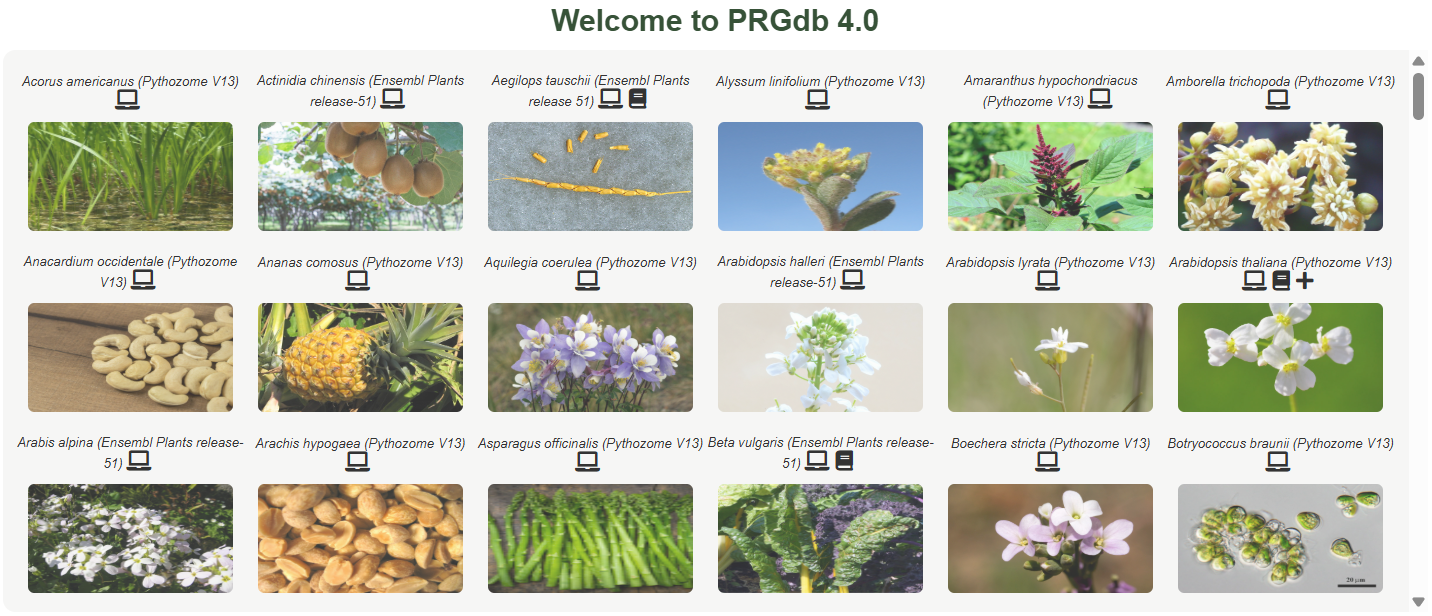
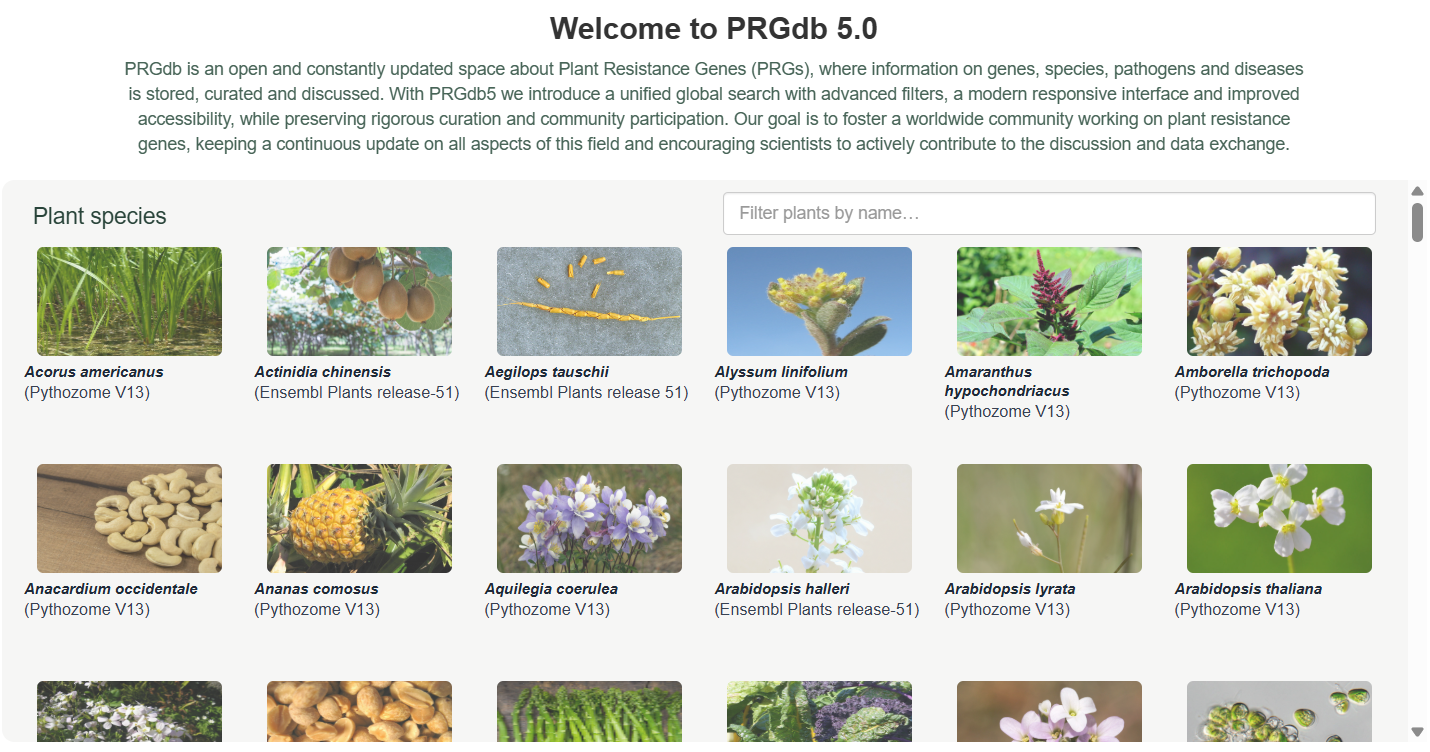
Visual Comparison: PRGdb4 vs PRGdb5
Before & After ComparisonDrag to compare
Use the slider below to compare the interface and features between PRGdb4 and PRGdb5. Drag the slider left or right to reveal the differences.
Getting Help
If you have questions or encounter issues:
- Check the tooltips and help text within each feature
- Review the documentation links provided in warning messages
- Contact the PRGdb team for support
Acknowledgments
PRGdb5 integrates data and services from:
- STRING Database - Protein-protein interaction networks
- Reactome - Pathway database and analysis
- Expression Atlas - Gene expression data
- UniProt - Protein sequence and functional information
- QuickGO - Gene Ontology annotations